Best Mortgage Rates In 2025

Elena Rodriguez
Certified Financial Planner · Updated October 2026

Elena Rodriguez
Certified Financial Planner · Updated October 2026
Imagine it is early 2025, and you are standing on the precipice of one of the most significant housing market shifts in recent memory. Many prospective buyers spent that year playing a high-stakes game of 'wait and see,' hoping for a dramatic drop in interest rates that never quite materialized in the way many anticipated. As we move through 2026, looking back at those fluctuations provides essential context for anyone currently attempting to navigate the complexities of home financing. The reality is that mortgage rates are rarely a straight line; they are a jagged staircase influenced by inflation, employment data, and central bank policy.
This article is designed to help you make sense of these historical trends and apply those lessons to your own financial decisions today. We will move beyond the simple headlines and dive into how actual borrower profiles impact what you pay at the closing table. Whether you are looking for a primary residence or an investment property, understanding the mechanics of rates is vital for long-term stability.
To provide some concrete context, during much of 2025, we saw 30-year fixed APRs ranging from 6.1% to 7.9%, depending heavily on credit quality and economic news cycles. The average loan amount for first-time buyers hovered around $415,000, while the timeline for closing a traditional mortgage remained relatively steady at 45 to 55 days. By understanding these numbers, you can better prepare your finances for the realities of today's market.
It is important to remember that rates are never guaranteed and vary significantly based on individual circumstances. What worked for a neighbor in 2025 might not be the optimal strategy for you in 2026. Use this guide as a roadmap, but always consult with specific lenders to understand your unique eligibility.
The economic turbulence experienced during 2025 has left a lasting imprint on the mortgage landscape of 2026. When the Federal Reserve adjusted interest rates to combat lingering inflation, it created a ripple effect that hit the secondary mortgage market almost immediately. For many borrowers, this meant that a rate quoted on Monday might be gone by Friday. This volatility forced many into 'panic buying' or, conversely, long periods of stagnation as they waited for a more favorable environment.
Understanding this volatility is crucial because it explains why lenders today are often more conservative with their terms. For example, if you were looking at a $350,000 loan in mid-2025 when rates were hovering near 7%, your monthly principal and interest might have been roughly $2,328. If you waited until the end of the year and rates dipped to 6.5%, that payment would drop to approximately $2,212. While a $116 difference per month might seem small in isolation, it represents over $37,000 in interest savings over the life of a 30-year loan.
The lesson from 2025 is that timing the market perfectly is nearly impossible. Instead of trying to predict when the bottom will occur, experts suggest focusing on your personal 'break-even point.' This involves calculating how much you would save by refinancing if rates drop in the future versus the upfront costs required to secure a lower rate today.
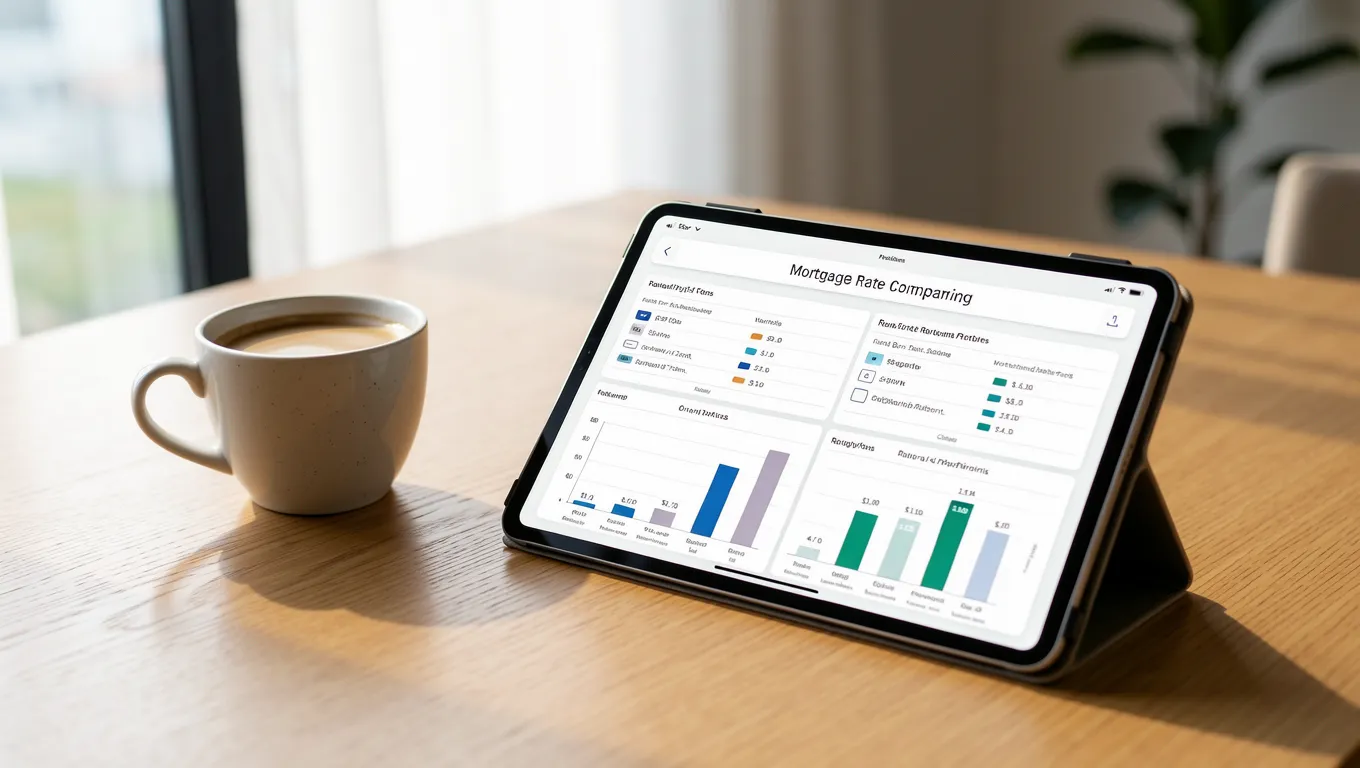
One of the most debated topics in recent mortgage history is whether to opt for a traditional 30-year fixed-rate mortgage or an Adjustable-Rate Mortgage (ARM). In many parts of 2025, the gap between these two options became narrow enough to make the decision quite difficult. A 30-year fixed rate offers the ultimate peace of mind; your payment stays exactly the same for three decades, regardless of what happens in the economy.
On the other hand, an ARM can offer a lower initial interest rate for a set period—typically five, seven, or ten years. Let's look at a comparison:
The trade-off is essentially between certainty and potential savings. If you plan to move or sell your home within five years, the ARM might be a highly efficient way to save money. However, if this is your 'forever home,' the stability of a fixed rate often outweighs the temporary benefits of an adjustable product. The risk of an ARM is that if rates are higher when your adjustment period begins, your monthly payment could jump significantly.
It is a common misconception that all borrowers with similar incomes will receive similar mortgage rates. In reality, your credit profile is perhaps the most significant factor in determining your actual APR. Lenders use your credit score to assess risk; the lower the perceived risk, the better the rate you can secure.
To illustrate this, let's consider a borrower looking at a $300,000 mortgage over 30 years. If Borrower A has an excellent credit score of 780, they might qualify for a rate of 6.5%. Their monthly payment would be approximately $1,896. However, if Borrower B has a moderate credit score of 660, they might only qualify for a rate of 7.75%, resulting in a monthly payment of $2,147. That is a difference of $251 every single month.
Over the course of a 30-year mortgage, that credit score discrepancy could cost Borrower B over $90,000 in additional interest. This makes it incredibly valuable to spend time improving your credit profile before you start shopping for rates. Simple actions like reducing credit card utilization or ensuring there are no errors on your Experian or Equifax reports can lead to massive long-term savings.
Many first-time homebuyers focus exclusively on the interest rate, but this is a tactical error that can lead to significant financial stress at the end of the transaction. When you see an advertised rate, it is often a 'teaser' that does not include all the costs associated with getting the loan. This is why understanding the Annual Percentage Rate (APR) is so vital.
Closing costs typically range from 2% to 5% of the total purchase price. On a $400,000 home, this could mean you need between $8,000 and $20,000 in cash just to finalize the loan. These costs cover things like appraisal fees, title insurance, government recording fees, and origination charges. Failure to budget for these upfront costs is a common pitfall that can derail even the most well-planned home purchase.
Another hidden cost to watch for is Private Mortgage Insurance (PMI). If your down payment is less than 20% of the home's value, you will likely be required to pay PMI. For example, on a $400,000 loan with a 5% down payment, PMI could add several hundred dollars to your monthly obligation for many years. Always ask your lender for a 'Loan Estimate' document early in the process; this standardized form allows you to compare lenders side-by-side and see exactly where your money is going.
In a competitive market, the lender you choose can be just as important as the house you buy. While big national banks are convenient, they are not always the most cost-effective options for every borrower. Many people find success by looking toward local credit unions or specialized mortgage brokers who may have different appetites for risk and different fee structures.
When comparing lenders, do not just look at the headline interest rate. One lender might offer a 6.5% rate but charge $3,000 in origination fees, while another offers a 6.7% rate with zero fees. You must calculate the total cost over the first few years of the loan to see which is truly cheaper. This process requires patience and organization.
To streamline this, you might use resources like Micro Loans to find potential matches among various lenders. By comparing multiple offers, you gain leverage in negotiations. Remember that even after you receive an initial quote, there is often room to negotiate certain fees or terms if you can show a competing offer from another reputable source.
The question of when to 'lock' your interest rate is one that keeps many homebuyers up at night. A lock ensures that even if market rates rise, your quoted rate stays the same for a set period (usually 30, 45, or 60 days). However, locking too early can be just as costly as waiting too long if rates continue to fall.
To make this decision effectively, follow this step-by-step framework:
If the market is highly volatile and moving rapidly downward, waiting might be tempting. However, most experts suggest that once you find a rate that fits your budget and matches your financial goals, locking in provides certainty that allows you to focus on other aspects of your move, such as inspections and insurance. The goal is not to win the market, but to secure a stable foundation for your homeownership.
Borrowers weighing this choice often look at bad credit loans and personal loans for bad credit as well.